
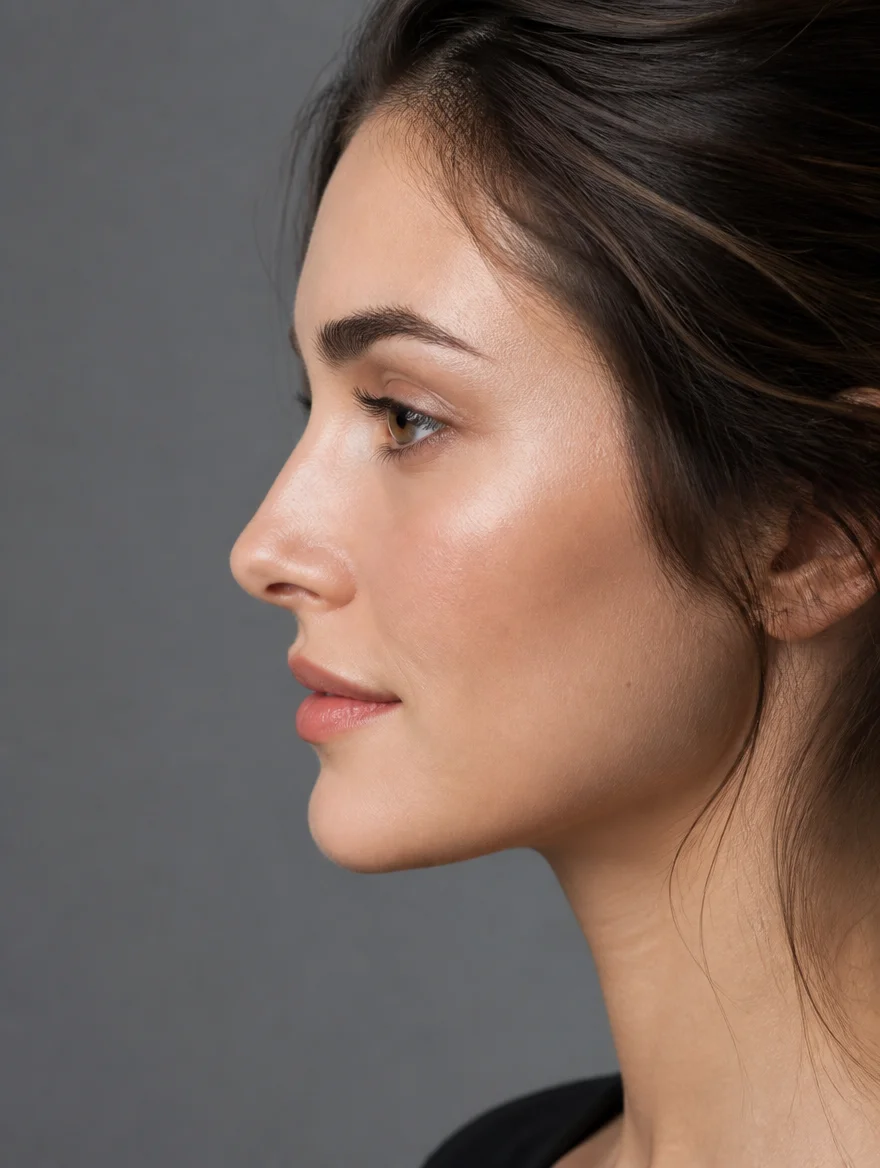
Rhinoplasty
Revision Rhinoplasty
Revision rhinoplasty corrects a previous unsuccessful nose surgery using rib, ear and DCF grafts to rebuild breathing and natural nasal form.
 Dr. Havva Duru Ipek wrote and medically reviewed this article · · Credentials and sources
| Duration of the operation | 3–5 hours |
|---|---|
| Anaesthesia | General anaesthesia |
| Onset of effect | Cast removed at day 7–10 |
| Permanence | Full result can take up to 18–24 months to resolve in complex cases |
| Return to daily life | Initial period similar to primary rhinoplasty (cast removed day 7–10) |
| Not carried out in | Not performed until at least 12–18 months after the previous operation |
| Number of sessions | Single surgical session |
Revision rhinoplasty is one of the most technically demanding procedures in facial surgery, reserved for patients whose first operation did not deliver the result they deserved. Every revision at Dr. Havva Duru İpek's Nişantaşı clinic is approached as a unique reconstructive challenge, combining advanced grafting techniques with meticulous restoration of both breathing function and natural nasal form.
Revision rhinoplasty nedir?
Revision rhinoplasty is surgery on a nose that has already been operated on once — combining structural reconstruction with aesthetic refinement. The gallery of results includes pollybeak deformity correction (transformation of the supratip area and restoration of a clean, refined profile), collapsed nasal valve repair (structural rebuilding with cartilage grafts alongside breathing improvement), over-resected bridge reconstruction (DCF and rib graft cases restoring natural bridge height and smooth contour), and tip malposition correction (asymmetric and over-rotated tips brought into natural, proportionate harmony).
Neyi sağlar, neyi sağlamaz?
- Structural rebuilding of the nasal framework.
- Nasal valve restoration for breathing.
- Advanced grafting using rib, ear or DCF cartilage.
- Expert scar tissue management.
- Breathing improvement alongside aesthetic correction.
- Symmetrical, tailored contouring.
Kimler için uygun?
Many patients arrive at the Istanbul clinic feeling frustrated after an unsatisfactory rhinoplasty, searching for a specialist who genuinely understands what went wrong and how to correct it. Dr. Havva Duru İpek routinely performs complex reconstructive revision work for:
- Pollybeak deformity — the drooping or heavy supratip that creates a beaked nasal appearance.
- Inverted-V deformity — middle vault collapse that affects both the aesthetic lines of the nose and nasal breathing.
- Collapsed nasal valve — loss of internal and external valve support, affecting airflow and structural integrity.
- Over-resection — a nose that was over-shortened or over-reduced in a previous surgery, sometimes described by patients as a "pig snout" appearance.
- Bridge irregularities — uneven, asymmetric or step-like deformities along the dorsum.
- Tip asymmetry and malposition — a tip that is twisted, over-rotated, under-projected, or lacks definition.
Every revision case is approached with a complete individual assessment — no two revision rhinoplasties are the same.
İşlem nasıl yapılır?
Because previous surgeries often deplete or damage the patient's natural nasal cartilage, rebuilding the structure typically requires advanced grafting material. The right technique is assessed carefully during consultation:
- Rib cartilage graft (costal graft) — the gold standard for severe revision cases, used when the septum has been fully depleted and significant structural support is needed to rebuild the bridge, tip, or both. Harvested from a small incision near the ribcage with minimal long-term impact.
- Ear cartilage graft (auricular graft) — ideal for more delicate contouring, tip support, or filling smaller structural deficits. Harvested from behind the ear, leaving virtually no visible scarring.
- DCF rhinoplasty (diced cartilage fascia) — diced cartilage wrapped in a thin layer of fascia to create a pliable, natural-feeling graft, avoiding the rigidity sometimes associated with solid rib grafts. Often the ideal solution for recreating a smooth, seamlessly natural nasal bridge.
- Revision without rib graft — if sufficient septal cartilage remains from the first surgery, a full revision rhinoplasty without rib harvest may be entirely possible; this is assessed with a thorough internal examination and imaging review.
Because of this complexity, scar tissue, and the frequent need to harvest cartilage from the ear or rib, revision surgery typically takes 3–5 hours — longer than a primary rhinoplasty.
İyileşme süreci
The initial downtime is similar to a first rhinoplasty — cast removal at day 7–10, with bruising subsiding within 2 weeks. However, internal swelling takes significantly longer to resolve after revision surgery, and the full final result requires extra patience — up to 18–24 months in complex cases. Many revision patients also suffer from collapsed internal or external nasal valves as a result of their first surgery; using specialised cartilage grafts, these valves can be reconstructed to permanently restore healthy, unobstructed airflow alongside the aesthetic improvements.
Riskler ve olası yan etkiler
Operating before the nose has fully healed from the first surgery is clinically dangerous: tissues are stiff, inflamed and unpredictable. This is why revision surgery is not performed until at least 12–18 months after the previous operation — the time needed for scar tissue to soften completely, blood supply to normalise, and the true underlying nasal structure to become clearly visible. A rib cartilage graft is only recommended if the septum has been fully depleted from prior surgery; if sufficient septal or ear cartilage remains, a less invasive graft approach may be adequate, and the right choice is assessed thoroughly during consultation.
Sık sorulan sorular
How long does a revision rhinoplasty take?
Because of the complexity, scar tissue, and the frequent need to harvest cartilage from the ear or rib, revision surgery typically takes 3–5 hours — longer than a primary rhinoplasty. The exact duration depends on the extent of correction required.
Will I need a rib graft?
Not always. A rib cartilage graft is only recommended if your septum has been fully depleted from prior surgery and significant structural rebuilding is required. If sufficient septal or ear cartilage remains, a less invasive graft approach may be entirely adequate. This is assessed thoroughly during your consultation at our Istanbul clinic.
Is recovery different from my first rhinoplasty?
The initial downtime is similar — cast removal at day 7–10, bruising subsiding within 2 weeks. However, internal swelling takes significantly longer to resolve after revision surgery, and the full final result requires extra patience — up to 18–24 months in complex cases.
Can revision rhinoplasty fix breathing problems caused by my first surgery?
Yes. Many revision patients suffer from collapsed internal or external nasal valves as a result of their first surgery. Using specialised cartilage grafts, Dr. İpek can reconstruct these valves to permanently restore healthy, unobstructed airflow alongside aesthetic improvements.
Why must I wait a full year before revision surgery?
Operating before the nose has fully healed from the first surgery is clinically dangerous. Tissues are stiff, inflamed and unpredictable. Waiting 12–18 months allows scar tissue to soften completely, blood supply to normalise, and the true underlying nasal structure to become clearly visible — all essential preconditions for safe and successful revision surgery.
Written and medically reviewed by: Dr. Havva Duru Ipek — Facial Plastic Surgery / Otolaryngology (Ear, Nose & Throat), Istanbul
Last reviewed: · Next review: 2027-09
Site editor: · Our editorial policy
Sources
Book an Appointment
The information here is general. What it means for your specific case will become clear after examination and any necessary tests. If you have prior test results or reports, please bring them with you.